I wrote the words “roaming SIM” again last week. I have written them thousands of times. This time I stopped halfway through the sentence, and not because the term was wrong. It was fine. It was accurate. It just wasn’t right, and I could not immediately explain the difference.
We call them roaming SIMs. We also call them multi-network SIMs, global SIMs, worldwide SIMs, M2M SIMs and IoT SIMs, and I have sat in meetings where all six were used about the same product within ten minutes and nobody blinked. Not one of those names is incorrect. Not one of them describes the thing.
So I started asking myself a question that has been quietly annoying me ever since: if we were inventing this technology today, with no history and no incumbents, what would we call it?
I have not found an answer. What I found instead was more interesting, and it is the reason this site exists.
Roaming used to mean something
In the GSM years, the vocabulary made sense. You had a SIM. The SIM belonged to an operator. That operator was your home network. When you left the country, your phone attached to somebody else’s network, that network was the visited network, and the two operators had an agreement covering it. You were away from home. You were roaming. Then you came back.
Every word in that sentence carried its own definition. Home meant home. Visited meant briefly. Roaming meant the temporary state in between, and it ended.
Then we started putting SIMs in things that do not travel.
A water meter in a chamber under a pavement in Rotherham does not go anywhere. It sits there for ten years. And for all ten of those years, it roams. It attaches to a visited network, every day, permanently, and it never comes home because it does not have one in any sense the word was built to carry.
That is the first crack, and everything else follows from it. We took a word whose entire meaning depended on a return journey and applied it to a device that will never make one. Nobody lied. The word simply arrived carrying a promise it could no longer keep.
Every generation abstracts something
This industry has a long habit of hiding one layer so the layer above gets easier. GSM abstracted the radio, so you stopped thinking about frequencies. GPRS abstracted packet switching. LTE eventually abstracted voice into just another application. Cloud abstracted the server. SD-WAN abstracted the wide area network. eSIM abstracted the plastic.
Every one of those got a name, and most of them got the name fairly quickly, because in each case somebody had a reason to sell the abstraction.
Modern IoT connectivity abstracted something we had never abstracted before.
It abstracted the operator.
Not the radio, not the transport, not the card. The counterparty. The company you have a relationship with. For the first time, you can buy mobile connectivity without buying it from a mobile network, and the mobile network your device actually depends on becomes a detail somebody else manages on your behalf.
That is a genuinely new thing. It is arguably the most widely deployed form of IoT connectivity in Europe. And twenty-five years in, we still have not agreed what to call it.
I think that is because naming a component is easy and naming the disappearance of a relationship is hard.
Three pictures
Before the vocabulary, the mechanism. Most of the confusion in this area dissolves the moment somebody draws it.
A native SIM.
Device
  |
Vodafone UK  (home network, real relationship, real contract)
You are a subscriber. Vodafone knows who you are. If something breaks, you have a counterparty and a contract.
A roaming or multi-network SIM.
Device
  |
KPN (NL)  <- home network on paper, holds the IMSI, authenticates the device
  |
EE / O2 / Vodafone / Three  <- visited networks, one at a time
Your device is in Birmingham. Its subscriber identity is Dutch. It attaches to a UK network as a foreign visitor. You have a contract with a UK reseller. Your device has no relationship whatsoever with the network it is actually using.
SGP.32 with a local profile.
Device
  |
downloads a local profile
  |
Vodafone UK  (home network, real relationship)
The device becomes a native subscriber. This is why SGP.32 matters, and it is worth noticing that the whole point of the newest standard in this space is to undo the arrangement the previous twenty years were built on.
Three architectures. One vocabulary, applied inconsistently across all of them.
Where does your SIM actually live?
Here is the part that surprises people who have been buying this stuff for years.
The network printed on the packaging is very often not the network the SIM belongs to. Most UK IoT connectivity providers do not run a UK mobile network. A good many do not run a mobile network at all. They resell access to somebody else’s core, and that core is frequently not in the UK. Your device powers up in Britain, attaches to EE or Vodafone or O2 or Three over the air, and its Home Public Land Mobile Network is somewhere else entirely.
Host networks commonly encountered in the UK IoT market include:
| Host network | Country | MCC/MNC | Notes |
|---|---|---|---|
| KPN | Netherlands | 204-08 | One of the most commonly encountered wholesale IoT host networks in Europe |
| Orange | France | 208-01 / 208-02 | Frequently used for international IoT connectivity and roaming services |
| JT | Jersey | 234-50 | Used by several IoT MVNOs, partly for the UK numbering |
| Sure | Guernsey | 234-55 | Another Channel Islands allocation seen in IoT connectivity |
| Deutsche Telekom | Germany | 262-01 | Appears in European IoT platforms and enterprise connectivity |
| Telefonica Germany | Germany | 262-07 | Seen in some multinational IoT deployments |
I want to be precise about what that table is and is not. It is not a list of who uses what. Those commercial relationships change as agreements are renegotiated, and any provider-to-host mapping I published today would be wrong within a year. The point is the category, not the roster: many UK IoT connectivity providers use wholesale host networks such as these, the exact one depends on the provider, and it may change without you being told.
None of this is secret and none of it is a scandal. It is an ordinary wholesale arrangement and it works well enough that most people never notice. But almost nobody explains it, so you get the slightly odd situation of an engineer in Leeds troubleshooting a connection that lives, as far as the network is concerned, in the Netherlands.
A worked example
A remote CCTV system goes in on a site in Sheffield. The installer buys a UK multi-network IoT SIM. The router picks EE, because EE has the strongest signal at that location.
Underneath:
- the IMSI belongs to KPN in the Netherlands, 204-08
- authentication happens against the KPN core
- billing runs through the IoT provider
- the device is roaming, and has never left Yorkshire
From the router’s point of view, everything works. From EE’s point of view, this is a long-term roaming subscriber. Both are correct. Only one of them is written on the datasheet.
But my SIM has a UK IP address
This is where a lot of people get turned around, and it is worth separating two things the vocabulary lumps together.
Where your device authenticates and where your data comes out are different questions with different answers.
The IMSI governs the first. It decides which core authenticates you, which operator you are a subscriber of, and therefore whether you are roaming. That is the signalling side, and it is the side that determines your regulatory standing and whether a visited network can decide it has had enough of you.
The second is a routing decision, and a good MVNO makes it independently. Plenty of providers run their own packet core, their own firewalls and their own breakout in the UK. So a device on a KPN IMSI can perfectly well hand you a UK IP address, break out in a British data centre, sit behind a UK-managed firewall and turn in latency that looks entirely domestic. Nothing about that is a trick. It is good engineering, and it is one of the things you are paying an MVNO for.
But it means the thing you can most easily observe, the IP address, tells you nothing at all about the thing that actually matters for permanent roaming. A UK IP is not evidence of a UK SIM. Local breakout solves the latency problem and the data residency problem. It does not solve the roaming problem, because the roaming problem lives one plane over, in signalling, where you cannot see it.
Two devices, side by side, both with UK IPs, both with sub-30ms latency, both apparently identical. One is a native subscriber. One is a permanent visitor whose host relationship is a commercial agreement it is not party to. You cannot tell them apart from the outside, which is rather the point of this whole essay.
How to check your own
This is worth sixty seconds of your time and it beats reading the marketing.
Put the SIM in a phone, or read the registration from the router, and look at four things: the IMSI, the MCC/MNC, the HPLMN and the registered PLMN. The first three digits of the IMSI are the mobile country code.
IMSI: 20408xxxxxxxxxxx
      204 = Netherlands
      08  = KPN
If the router is bolted to a wall in the UK and the IMSI starts 204, it is roaming every day of its life. 208 is France. 262 is Germany.
One wrinkle worth knowing, because it catches people out. 234 is a UK country code, but the 234 block is not simply “British networks”. It also carries the Crown Dependencies: JT sits at 234-50, Sure Guernsey at 234-55, Sure Isle of Man at 234-36 and Manx Telecom at 234-58. A SIM reporting 234 is therefore not automatically a UK-native SIM, and a device on a Jersey IMSI in Manchester is still a visitor.
It runs the other way too. Tismi BV holds 234-09, and Tismi is a Netherlands-registered company. Mass Response Service GmbH, an Austrian outfit, holds 234-40. The 234 block contains foreign-registered entities with UK allocations just as it contains UK-adjacent islands. So the country code alone settles nothing in either direction. You need the operator code, and then you need to know who that operator code actually belongs to, which is exactly the sort of thing nobody should have to look up to understand what they bought.
That is not a criticism of the product. It is just the mechanism, and you are entitled to know it.
What are we actually trying to name?
This is where I got stuck for a while, and it turned out to be the actual answer.
We are not disagreeing about words. We are naming different objects and assuming we are talking about the same one.
Look at what each term points at:
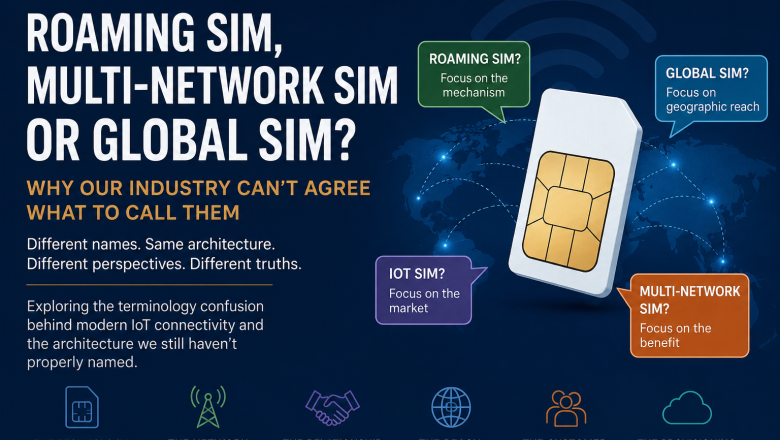
- Roaming SIM names the SIM, and describes its attachment behaviour.
- Multi-network SIM names the experience, from the buyer’s seat.
- Global SIM names the geographic reach.
- IoT SIM names the intended market. It tells you who is supposed to buy it and nothing else.
- eUICC names the provisioning technology.
- Multi-IMSI names the subscriber identity.
- Foreign-core names the architecture.
Seven terms. Seven different referents. Not one of them names the service.
So when two people argue about whether something is “really” a multi-network SIM or “just” a roaming SIM, they are not disagreeing about facts. One is describing the outcome and the other is describing the mechanism, and both are right, because they are looking at different parts of the same animal from opposite ends.
No wonder we never converged. You cannot converge on a name for a thing when everybody is naming something else.
What each term reveals and conceals
Once you see it that way, you can lay it out honestly. Every term in this market does two things: it shows you one true thing, and it quietly declines to mention another.
| Term | What it describes | What it leaves out |
|---|---|---|
| Roaming SIM | The mechanism | That it never ends |
| Multi-network SIM | The benefit | Why the benefit exists |
| Global SIM | Geographic reach | More or less everything |
| IoT SIM | The intended buyer | The architecture entirely |
| eUICC | How profiles get on the card | What connectivity model results |
| Multi-IMSI | The identity layer | Everything above it |
| Foreign-core SIM | The architecture | Whether that matters to you |
Read the two columns together and the pattern is obvious. Roaming SIM tells you how but not for how long. Multi-network tells you what you get but not why you get it. Put those two together and you have the whole object: a SIM that reaches every network because it is permanently a visitor on all of them.
Which is precisely why you will never see those two terms used in the same sentence by anyone selling one. Each vendor picks the accurate half that flatters, and the halves are never in the room together.
I want to be careful here, because this is the point where an article like this usually turns into an accusation, and I do not think the accusation is warranted.
Nobody chose this. Everybody maintained it.
There is no conspiracy. There is something more interesting, which is that every group involved named the thing correctly from where they were standing.
The network engineers looked at it and saw IMSIs, because that is what they configure. The standards people looked at it and saw provisioning mechanisms, because that is what they specify. Sales looked at it and saw resilience, because that is what customers respond to. Product managers looked at it and saw a market segment. Customers looked at it and saw coverage, because coverage is the only part they can observe.
Six perspectives, six perfectly reasonable names, none of them wrong, none of them complete, and no authority anywhere with the standing or the motive to pick one.
Including us
I should be straight about something, because otherwise this whole essay is a man complaining about a room he is standing in.
Look at the top of this site. There is a page called IoT SIM Cards. There is one called Multi-IMSI SIM. There is one called IoT eSIM. There is a Roaming eSIM page and, separately, a Multi-Network eSIM page. Five entries in a menu, and by the argument I have just spent two thousand words making, most of them are describing one architecture from different angles.
I know. I wrote them.
And here is the thing I cannot get around, which is also, I think, the real answer to why none of this ever gets fixed. I cannot stop. If I renamed those pages tomorrow to something more honest, nobody would ever find them. There is no search volume for “hosted SIM architecture”. There is no search volume for “foreign-core connectivity”. People type “multi-network SIM” into Google because that is the phrase the industry taught them, and the only way to be found by somebody looking for a multi-network SIM is to use the words multi-network SIM.
So the vocabulary is not a marketing conspiracy. It is a coordination problem. Every individual actor, including this one, is better off using the established terms even when they know the terms are incomplete, because the alternative is being precise and invisible. Nobody can defect alone. The first person to use honest language pays the entire cost of it and captures none of the benefit, which is exactly the shape of problem that never solves itself.
That is why this piece is an essay and not an announcement. I am not telling you I have stopped saying roaming SIM. I have not. I said it four times on the way to writing this sentence, and the domain this is published on is called roamingsim.co.uk, which rather settles the matter.
What I think can change is smaller. Not the words we use to be found. The words we use once we are actually talking to each other. The datasheet can say multi-network SIM, because that is what you searched for. The conversation after it can say which IMSI, whose core, roaming or native, and for how long.
That is not a solution. It is just the only bit of ground I can see that is actually available.
Which brings me to the question I genuinely had not thought to ask until recently.
Who owns the definition?
Nobody.
“Roaming SIM” is not a GSMA product category. Neither is “multi-network SIM”, “global SIM” or “IoT SIM”. You will not find any of them defined in a specification. The standards bodies have been busy and precise about components, and they have done that work properly: SGP.02, SGP.22 and SGP.32 are real documents with real definitions. But they define provisioning architectures, not product categories.
The product vocabulary in this market was not specified. It accreted. Somebody’s marketing department in about 2014 needed a phrase for the datasheet, a competitor matched it because it sounded good, and a decade later that is simply what the category is called.
Normally the sequence runs: technology appears, standards emerge, industry agrees terminology, marketing adopts it. This market ran it backwards. Technology appeared, marketing invented names, vendors invented different names, standards carried on describing components, and nobody ever named the complete architecture.
That is unusual. Not unique, before anyone writes in. Fixed wireless access wandered around for years without a settled name, and “business broadband” still means whatever the seller needs it to mean. But it is unusual for a category this large to have no agreed name at all.
The design review
So I started writing candidates down. Not to launch one. Mostly to work out why each one failed, because the failures were more instructive than the attempts.
Hosted SIM. Hosted by KPN. Hosted by Orange. Honest, because it names the relationship, and the relationship is the uncomfortable part. Invites the right follow-up question, which is what happens when the host declines. Slightly dull. Survives.
Foreign-core SIM. Technically unarguable and checkable from the PLMN in sixty seconds. But note what the breakout point does to it: a SIM can have a foreign core for authentication and a UK core for data, so the term is precise about one plane and silent about the other. Which is the same disease as everything else on this list, just contracted more honestly. Survives, with a caveat.
Aggregated connectivity. Describes what the provider does, which is aggregate commercial agreements. But it names the benefit and hides the mechanism, which is the multi-network trick wearing a newer suit. Also, “aggregation” already means something specific in LTE and we do not need the collision.
Brokered connectivity. I like this more than I expected. The provider does not own networks. It brokers access. Honest about the intermediation. Slightly pejorative in a way that is probably deserved.
Connectivity virtualisation. This is the one I wanted to work, and I spent longer on it than any of the others.
The case for it is strong. Every previous abstraction earned a name of this shape. We virtualised servers, then storage, then networking, and now we are virtualising the operator. It mirrors the pattern exactly. And the standard objection, that it does not tell you what is underneath, is not really an objection at all, because cloud computing does not tell you where the servers are either and nobody minds.
Here is why I still think it fails, and it is a fine distinction.
The reason “cloud” is an acceptable abstraction is that the abstraction holds. AWS really does insulate you from the hardware. That insulation is the product. When you buy it you are buying the right not to think about the layer below, and you get it.
Connectivity virtualisation does not hold. Your device is on EE’s actual radio, subject to EE’s actual policies, with no contract and no standing. You are not insulated from the operator. You are more exposed to them than a native subscriber is, because a native subscriber has a commercial relationship and your device has a visitor pass. The abstraction is real at the point of sale and evaporates at exactly the moment it matters, which is when the visited network decides it has had enough.
A term that names an abstraction which fails under load is not describing the product. It is describing the brochure.
So: rejected, but honourably, and I would rather someone talked me back round on it than have it quietly dropped.
Operator-abstracted connectivity, network-abstracted connectivity, software-defined connectivity. All three are accurate. All three are five syllables too long. None of them will ever be said out loud by a person buying forty SIMs.
Where I have got to
I have not found the name. I am not sure one exists, and I am fairly sure I am not the person who gets to declare it.
What I have got to is smaller and, I think, more useful.
The industry does not need another synonym. It needs to stop pretending that “roaming SIM”, “multi-network SIM”, “global SIM” and “IoT SIM” describe four different products. In the overwhelming majority of cases they describe one architecture, viewed from four flattering angles, and no honest single term ever emerged because nobody could afford to be the one who used it.
The practical upshot is not a vocabulary. It is a habit. When somebody says multi-network, ask which networks, on whose IMSI, roaming or native. When somebody says roaming, ask returning home when. When somebody says global, ask where the core is, and then ask separately where the breakout is, because the answers are not the same and the difference is the whole game. None of those questions are hostile. All of them are unanswerable in marketing copy, which tells you something.
And the bigger thought, the one I keep coming back to: we have spent twenty-five years arguing about SIM cards when the thing we actually invented was a new kind of mobile connectivity service. The card is the least interesting part of it. We named the card because the card was the bit we could hold.
I would genuinely like to know how other people in this industry think about this. Not because I want agreement. Because I suspect several of you have been carrying the same low-level irritation for years and have simply been too polite, or too busy, to say it out loud.
If you have a better name, I would like to hear it. If you think the whole exercise is pointless because everybody knows what a roaming SIM is anyway, I would like to hear that too, and I would want to ask you what the water meter in Rotherham thinks it is doing.
This site exists to explain the technology behind the terminology. Roaming SIM, multi-network SIM, global SIM, IoT SIM: none are wrong, none tell the whole story. Everything published here sits under that mission.