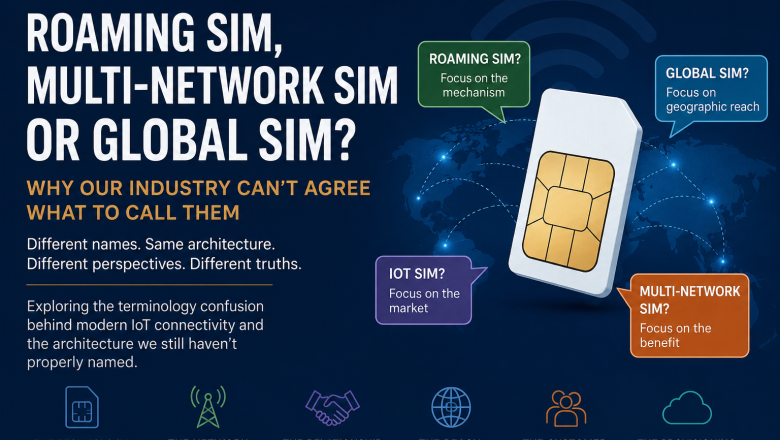
What Are We Actually Naming? Twenty-Five Years of Arguing About SIM Cards
I wrote the words “roaming SIM” again last week. I have written them thousands of times. This time…
Read article →Multi-IMSI SIM, eSIM, IoT SIM and fixed IP data solutions. All four UK networks on a single SIM. No dead zones. No single point of failure.
From multi-IMSI industrial SIM cards to travel eSIMs for MiFi hotspots. Find the right connectivity solution for your use case.
Multiple network identities on one SIM. Automatic steering to the best network. No single point of failure.
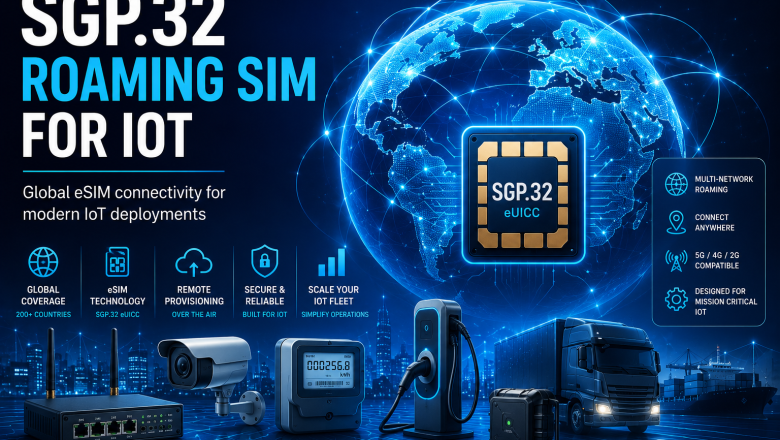
MFF2 and plug-in form factors. Remote SIM provisioning via GSMA SGP.02 and SGP.32. No physical SIM swap needed.
M2M data SIM cards for routers, gateways, CCTV, telemetry and industrial devices. UK and worldwide options.
Static public IP address on your SIM. Essential for VPN tunnels, SCADA access and remote device management.
eSIM with international roaming built in. Switch profiles remotely when entering new territories.
eSIM that carries profiles for multiple operators. Connects to the strongest available network at any location.
Stay connected in 180+ countries without bill shock. Pre-pay travel SIM cards for phones, tablets and MiFi routers.
Pocket Wi-Fi routers, 4G dongles and mobile hotspot devices. Full guide and reviews at dongle.co.uk.
Your device connects to the strongest signal at any location. No manual reconfiguration. No dead zones where at least one network has coverage.
A fixed IP SIM card (also called a static IP SIM) retains the same public IP address every time the device connects to the network. Without a fixed IP, the IP address changes at every reconnection — making it impossible to initiate a connection to the device without dynamic DNS workarounds or a VPN concentrator.
Fixed IP SIMs are essential for any deployment where you need to reach the device: industrial routers running VPN tunnels, IP cameras and CCTV systems, SCADA and PLC remote access, ATM and payment terminal management, utility meter reading systems.
Public vs private IP: a public fixed IP is directly reachable from the internet. A private fixed IP (via private APN) is only reachable from within a secure VPN or MPLS network — better for high-security environments. We offer both. Contact us to discuss private APN configurations.
All plans include all four UK networks, fixed public IP, and SIM management platform. Data is pooled. No setup fees. 12-month Direct Debit.
Need NB-IoT, private APN, multi-IMSI or eSIM? Get a custom quote.
Industrial connectivity that works where standard SIMs fail.
Vehicle tracking, driver behaviour, tachograph integration. UK and European roaming.
Asset and equipment tracking. Works in rural areas where single-network SIMs drop out.
PDQ machines, kiosks, vending and ATMs. High availability, low data, fixed IP.
Remote content updates over cellular. Pooled data keeps costs manageable at scale.
PLC access, industrial automation, utility systems. Fixed IP essential.
Remote patient monitoring, medical equipment telemetry, ambulance connectivity.
Field equipment, industrial assets, construction plant. Track, monitor and manage.
Connected vehicles, EV charging point monitoring, in-car entertainment systems.
See the full list of supported use cases and vertical market solutions.
No fluff. No sales patter. If the answer isn't here, ask us directly.
In-depth technical articles on IoT connectivity, SIM management and industrial networking.
I wrote the words “roaming SIM” again last week. I have written them thousands of times. This time…
Read article →In-Depth Technical Guide Why Your Multi-Network SIM Didn’t Switch – and What Nobody Told You About How Roaming…
Read article →eSIM and IoT Connectivity SGP.32 and the Roaming SIM: What Changes, What Stays, and What to Do Now…
Read article →One SIM or a thousand. Tell us what you're building and we'll spec the right solution. No obligation. No sales scripts.